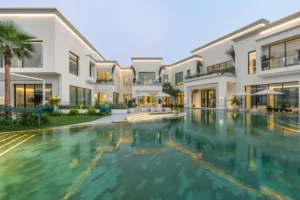


Dubai’s two Palms are not two versions of the same investment. Palm Jumeirah is a finished, lived-in island with observable rents, resale prices and service costs. Palm Jebel Ali is a much larger, still-building island sold in controlled releases. The smart question is therefore not which island is “better” — it is what kind of risk, income and timeline the buyer wants.
What you are actually buying
Palm Jumeirah has been operational for roughly fifteen years, with hotels, restaurants, beach clubs, marinas and a deep resale market. A buyer there can inspect the home, check recent comparable sales in the same community, and see rental demand in real time.
Palm Jebel Ali is at the opposite stage: low-density beachfront villa product on a Nakheel masterplan, roughly twice the size of Palm Jumeirah at masterplan level, with construction still under way. One 2026 comparison reports that Nakheel awarded roughly AED 3.5 billion in villa construction contracts in April 2026 covering 544 villas across the early fronds. That is a reported figure from a market comparison, not a delivery guarantee.
On timing, the two cohorts should not be confused: early Beach and Coral Collection villas on Fronds K to P hand over in phases from late 2026 through 2027, while the 544 villas on Fronds A to F contracted in April 2026 target completion in the fourth quarter of 2028. Full island buildout runs into the 2030s. All of these dates are targets, not guarantees.
What the top-end sales actually show
The clearest like-for-like evidence comes from the $10 million-plus segment in the first eight months of 2026, as reported from Knight Frank data. It covers only that top segment — not average prices across either island — so it should not be read as a whole-market average.
Palm Jebel Ali villas: 43 transactions in the $10 million-plus bracket, totalling AED 2.04 billion, an average of AED 47.5 million.
Palm Jumeirah villas: 28 transactions, totalling AED 1.85 billion, an average of AED 66.2 million.
In other words, at the very top end, Jebel Ali recorded more $10 million-plus villa deals in that period, while Jumeirah’s average deal value was higher. That fits the two islands’ stages: Jebel Ali is releasing large new villa stock, while Jumeirah’s stock is established and, at the prime end, more expensive per deal.
The case for Palm Jumeirah
Jumeirah answers the question Jebel Ali cannot yet answer: what is it worth today? Every input — rent, resale spreads, hotel performance, service charges — is observable. A buyer who wants to live there tomorrow, or to let the property now, does not have to underwrite a construction timeline or an infrastructure build-out.
Its weakness is the mirror image: entry prices at the prime end are already high, and the strongest appreciation curve — the one early Jumeirah buyers rode as the island matured — is behind it. New ultra-prime launches on the island show what scarce new product commands in a proven location, but they are priced as proven-location product.
The case for Palm Jebel Ali
Jebel Ali’s case is scarcity plus cycle timing: low-density beachfront villa product that is hard to replicate, sold in controlled releases while Dubai is structurally short of exactly that stock. Staged payment plans also let a buyer control a large asset with a fraction of the capital committed while the island builds out around it.
Its weakness is equally clear: no rental income until handover and critical mass, an assignment-driven resale market until then, and delivery-timeline and infrastructure risk on top of ordinary market risk. A buyer here is underwriting a promise, however well-funded the construction programme appears.
The bottom line
A buyer who needs income, liquidity and a home to use now has a straightforward answer: Palm Jumeirah. A buyer with a five-to-ten-year horizon, who can carry an illiquid asset through construction and wants early-entry pricing on a large new waterfront masterplan, has a genuine reason to look at Palm Jebel Ali.
The balanced position — and the one several 2026 comparisons reach — is not to treat the two as a choice at all: Jumeirah for stability and observable value, Jebel Ali for growth exposure. The mistake to avoid is pricing Jebel Ali as if it were already Jumeirah, or judging Jumeirah as if it still offered early-cycle entry pricing. They are different assets at different stages, and the price should reflect that.