
A modern luxury rich home office is no longer simply a room with an expensive desk and an impressive chair. For executives, entrepreneurs, investors, creators, and other professionals who spend much of their working life at home, the office has become a carefully engineered environment for concentration, privacy, comfort, and professional presence.
The best luxury home offices combine high-end interior design with practical technology and serious ergonomics. A beautiful room can still be frustrating if video calls echo, sunlight hits the monitor, cables are visible everywhere, or the chair becomes uncomfortable after two hours.
That is where thoughtful planning matters.
In 2026, the strongest luxury office designs focus less on displaying wealth and more on creating a space that works exceptionally well. Bespoke furniture, architectural lighting, acoustic treatment, concealed technology, art, premium materials, wellness features, and reliable connectivity can all contribute to the experience.
This updated guide explains what actually makes a home office luxurious, which features are worth prioritizing, common design mistakes to avoid, and how to create an elegant workspace without sacrificing everyday usability.
What Defines a Modern Luxury Home Office?
Luxury is often confused with expense. In practice, an expensive home office isn’t necessarily a luxury workspace.
A truly premium office usually has five characteristics:
- Purpose-built design
- Exceptional comfort
- Integrated technology
- Privacy and acoustic control
- Personal character
The difference becomes obvious after several hours of work.
A $20,000 desk placed in an ordinary room may look impressive in photographs but perform poorly. Meanwhile, a thoughtfully designed room with excellent acoustics, natural light, ergonomic furniture, concealed wiring, and carefully selected materials can feel significantly more luxurious.
The guiding principle should therefore be performance first, visual luxury second.
Why Luxury Home Offices Have Changed
Remote and hybrid work permanently changed how people think about residential space.
A home office once served as an occasional study or a place to pay bills. Today, it may function as:
- A daily executive workspace
- A private video-conferencing studio
- A creative production room
- A reading library
- A client meeting space
- A financial or investment workspace
- A writing or recording environment
That multifunctional role has pushed high-end residential design toward more sophisticated solutions.
The office also has an unusual requirement: it needs to look good from both sides.
The person sitting inside should feel comfortable and focused, while colleagues on a video call see a professional background with controlled lighting, balanced composition, and minimal distractions.
The Essential Elements of a Luxury Rich Home Office
1. A Bespoke Desk That Fits the Room
The desk is usually the visual anchor of a luxury office, but size alone shouldn’t determine its quality.
A custom desk can be designed around:
- The user’s height
- Monitor placement
- Cable routing
- Storage requirements
- Window position
- Lighting
- Meeting arrangements
Premium materials might include walnut, oak, marble, natural stone, leather, metal, or carefully finished veneers.
One practical improvement that’s frequently overlooked is integrated cable management.
Power outlets and data connections can be built into the desk or positioned beneath it, allowing cables to disappear from view.
That small detail can make a bigger difference to perceived luxury than an expensive decorative accessory.
Should you choose a traditional or modern desk?
A traditional executive desk works particularly well in libraries and classical interiors.
A minimalist stone, wood, and metal desk suits contemporary architecture.
The right choice should complement the architecture rather than compete with it.
2. The Executive Chair: Don’t Compromise on Ergonomics
The chair is arguably more important than the desk.
An expensive leather chair that provides poor lumbar support is not a luxury after an eight-hour workday.
A high-quality executive chair should provide:
- Adjustable seat height
- Proper lumbar support
- Adjustable armrests
- Appropriate seat depth
- Breathable or premium upholstery
- Stable reclining support
- Easy adjustment
Leather remains popular in traditional luxury interiors, while premium mesh and technical fabrics can work better in contemporary spaces.
The best approach is to test a chair before purchasing it whenever possible.
Luxury should be felt, not merely photographed.
3. Architectural Lighting Makes a Major Difference
Lighting is one of the most underestimated parts of high-end office design.
A room can contain beautiful furniture and still look ordinary if the lighting is harsh or poorly positioned.
A sophisticated setup normally combines several layers.
Ambient lighting
Provides overall illumination throughout the room.
Task lighting
Directs light toward the desk or reading area.
Accent lighting
Highlights artwork, bookshelves, architectural features, or collectibles.
Natural light
Windows can dramatically improve the atmosphere, although direct sunlight needs to be controlled.
Automated blinds or shades can help manage glare while maintaining natural daylight.
For video meetings, lighting should illuminate the face evenly without creating deep shadows or making the background excessively bright.
4. Acoustic Design Is a Hidden Luxury
One of the most valuable improvements in an executive home office is something visitors may never notice: good acoustics.
Hard surfaces such as marble, glass, polished wood, and large windows can create reflections and echo.
That can make video calls sound unprofessional even when the room looks spectacular.
Luxury offices can address this through:
- Acoustic wall panels
- Heavy curtains
- Rugs
- Upholstered furniture
- Bookshelves
- Acoustic ceiling treatments
- Door seals
- Insulated walls
A particularly effective strategy is to combine acoustic treatment with interior design.
Instead of adding obvious studio panels afterward, acoustic materials can be incorporated into wall art, wood slats, upholstered sections, or architectural features.
This is one of the clearest examples of where functional luxury beats decorative luxury.
5. Technology Should Disappear Into the Design
A modern luxury office may contain considerably more technology than a conventional workspace, but ideally you shouldn’t see most of it.
The goal is technology without visual clutter.
Consider integrating:
- High-speed wired networking
- Wi-Fi access points
- Multiple displays
- High-quality webcam
- Professional microphone
- Speakers
- Smart lighting
- Automated blinds
- Climate control
- Wireless charging
- Power management
- Backup connectivity
Monitors can be mounted on concealed arms or integrated into custom cabinetry.
Speakers can be installed into walls or ceilings.
Power outlets can be positioned exactly where equipment requires them.
The result is a room that looks calm while quietly supporting sophisticated technology.
6. Build a Professional Video-Call Background
The home office has also become a visual representation of its owner.
For professionals who regularly appear on Zoom, Teams, or other video platforms, the background deserves deliberate planning.
A good background might include:
- Carefully arranged books
- Artwork
- Architectural shelving
- Plants
- A statement lamp
- Subtle decorative objects
- A clean wall treatment
The biggest mistake is trying to make the background look expensive by filling every available surface.
Luxury usually benefits from restraint.
A few meaningful objects are generally more convincing than dozens of decorative pieces.
7. Art Gives the Office Personality
Furniture establishes the structure of the room. Art gives it identity.
A luxury office might include paintings, photography, sculptures, antique objects, limited-edition prints, or personal collections.
The selection doesn’t necessarily need to be expensive.
A personally meaningful piece can have greater value to the owner than a generic artwork chosen simply because it looks prestigious.
Placement matters too.
Artwork should work with the proportions of the room and shouldn’t interfere with the primary camera angle.
8. A Private Library Still Has a Place
Despite the growth of digital information, libraries remain popular in luxury offices.
Built-in shelving can provide:
- Storage
- Acoustic absorption
- Visual warmth
- A professional backdrop
- Space for personal collections
A floor-to-ceiling bookcase can also make a room feel architecturally complete.
However, books should be organized naturally rather than arranged purely for appearance.
A bookshelf that looks like a movie set can make an office feel artificial.
Luxury Home Office Styles to Consider
Different architectural styles call for different office approaches.
Contemporary Luxury Office
Typical characteristics include:
- Clean lines
- Neutral materials
- Large windows
- Minimal furniture
- Integrated technology
- Stone and wood
- Sculptural lighting
This style works particularly well in modern apartments and newly built luxury homes.
Traditional Executive Office
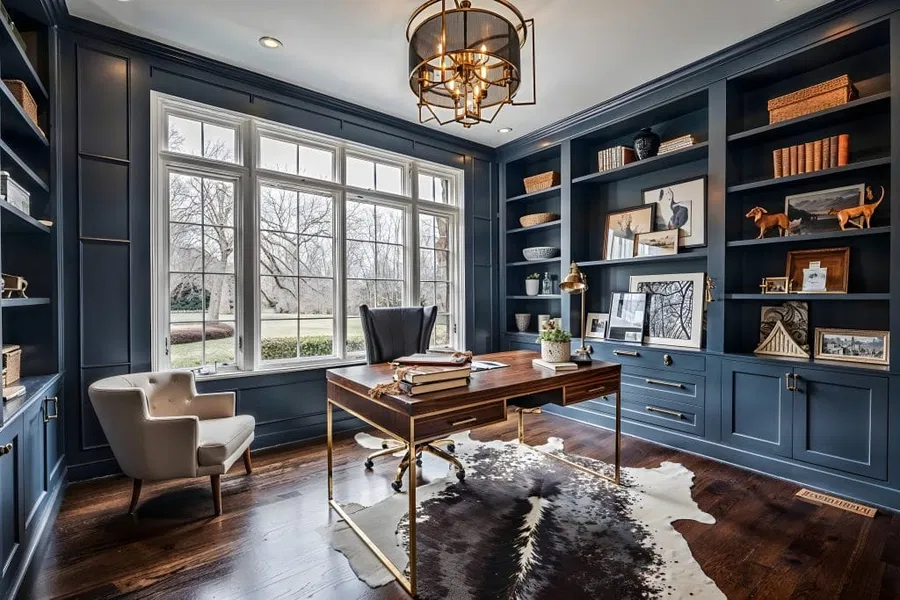
This approach may feature:
- Dark wood
- Leather
- Built-in bookshelves
- Brass details
- Classic artwork
- Traditional desk
- Decorative molding
It creates a more established, formal atmosphere.
Warm Modern Office
This is increasingly attractive for homeowners who want sophistication without creating a corporate environment.
It combines:
- Natural wood
- Soft textiles
- Neutral colors
- Contemporary furniture
- Plants
- Warm lighting
The result is polished but comfortable.
The Wellness Side of a Luxury Office
A premium workspace shouldn’t encourage someone to sit motionless for ten hours.
Wellness features can be surprisingly simple.
Consider adding:
- A standing desk option
- Comfortable walking space
- A small stretching area
- Indoor plants
- Air-quality monitoring
- Good ventilation
- Natural daylight
- A comfortable lounge chair
- A nearby water station
- A quiet reading corner
A separate meditation or wellness room can be worthwhile in very large homes, but it isn’t essential.
Often, creating enough space to stand, stretch, and move around is more useful.
How Much Does a Luxury Home Office Cost?
There is no universal price because the scope of a luxury office can vary enormously.
A relatively modest premium renovation might involve:
- High-quality desk
- Executive chair
- Professional lighting
- Custom storage
- Better networking
- Acoustic improvements
A major architectural project could additionally involve:
- Custom millwork
- Stone surfaces
- New electrical infrastructure
- Dedicated HVAC
- Sound isolation
- Automated shades
- Integrated AV
- Smart-home controls
- Bespoke furniture
The important point is that budget should follow priorities.
If you have $50,000 available, spending nearly all of it on an extravagant desk while ignoring acoustics, lighting, and networking is usually a poor allocation.
A better order is:
- Architecture and room layout
- Electrical and network infrastructure
- Ergonomics
- Lighting
- Acoustics
- Technology
- Furniture and materials
- Decorative details
Common Luxury Home Office Mistakes
Even expensive offices can get the basics wrong.
Buying furniture before measuring the room
A massive desk can overwhelm a smaller room and restrict movement.
Measure first and establish circulation paths.
Ignoring camera positioning
A beautiful office may look terrible on video if the camera faces a bright window.
Determine the primary camera position before finalizing the furniture layout.
Overdecorating
Too many objects create visual noise.
Luxury design generally benefits from negative space.
Forgetting heat and ventilation
Powerful computers, monitors, lighting and networking equipment can generate considerable heat.
A comfortable room needs adequate climate control.
Treating technology as an afterthought
Retrofitting cables and outlets after construction can damage an otherwise elegant design.
Plan infrastructure before installing finishes.
Prioritizing appearance over comfort
The ultimate test isn’t whether the office photographs well.
It’s whether you can work there comfortably at 4 p.m. on a busy Thursday.
Three Less-Obvious Insights About Luxury Offices
The most expensive-looking office may not be the most luxurious
True luxury is increasingly associated with quietness, convenience and personalization rather than obvious extravagance.
A hidden charging station can be more useful every day than a decorative $10,000 object.
The ceiling deserves attention
People often design walls and floors carefully but ignore the ceiling.
Yet the ceiling affects lighting, acoustics, ventilation, and the camera frame.
A well-designed ceiling can quietly improve the entire room.
Design for the work you actually perform
An investment professional, architect, gamer, writer, CEO, designer, and musician may all require completely different offices.
The ideal luxury office isn’t a showroom.
It is a physical expression of someone’s working habits.
A Practical Planning Process
If you’re creating a luxury home office from scratch, don’t begin by shopping for furniture.
Follow this sequence:
Step 1: Define the work
Write down how you actually use the room.
Do you spend most of your time on calls, writing, analyzing documents, managing teams, creating content, or meeting clients?
Step 2: Select the room
Prioritize natural light, privacy, noise levels, ceiling height, and connectivity.
Step 3: Plan infrastructure
Determine locations for power, data, lighting, displays, speakers, cameras and climate controls.
Step 4: Establish the camera angle
This is especially important for executives and public-facing professionals.
Step 5: Solve acoustics
Address echo and outside noise before installing decorative finishes.
Step 6: Choose furniture
Only after the room’s dimensions and requirements are understood.
Step 7: Add personality
Finish with artwork, books, plants, collectibles and other meaningful objects.
Is a Luxury Home Office Worth It?
For someone who works from home occasionally, probably not at an extravagant level.
But for a professional who spends most working days at home, the calculation changes.
A well-designed office can improve comfort, organization, privacy, video-call quality and the separation between professional and personal life.
The biggest return doesn’t necessarily come from the most expensive materials.
It comes from designing the room around the person using it.
That distinction separates a genuinely luxurious workspace from an expensive room.
FAQ
What makes a home office look luxurious?
A luxury home office typically combines high-quality materials, custom furniture, thoughtful lighting, excellent ergonomics, acoustic control and carefully integrated technology. The overall design should feel intentional rather than simply expensive. Personal artwork and meaningful objects can add more character than excessive decoration.
What is the best desk for a luxury home office?
The best desk depends on the room and the user’s work. A bespoke wood, stone or metal desk can provide an impressive centerpiece, but its dimensions, ergonomics and cable management matter more than the material alone. A height-adjustable option can also provide additional flexibility.
How can I make my home office look expensive without overspending?
Start with lighting, organization, quality seating and a clean layout. Add one or two strong design elements, such as custom shelving, a beautiful desk lamp or distinctive artwork, instead of filling the room with expensive accessories. Concealed cables and clutter-free surfaces also make a surprisingly large difference.
Are luxury home offices still relevant in 2026?
Yes, particularly for people who work remotely or follow hybrid schedules. The modern office has also evolved into a space for video meetings, creative work, private calls and focused individual work. As a result, good acoustics, connectivity, ergonomics and lighting have become as important as visual design.
How much should I spend on a luxury home office?
There is no fixed amount. The cost depends on whether you’re furnishing an existing room or undertaking architectural renovation. A sensible approach is to spend first on infrastructure, comfort, lighting, acoustics and technology before allocating money to purely decorative luxury.
Final Thoughts
The modern luxury rich home office has evolved considerably from the traditional executive study.
Today, the best spaces combine design, technology, privacy, comfort and personal identity. A beautiful desk is useful, but it is only one component of a successful workspace.
The smartest approach is to design around real working habits. Solve the practical problems first—lighting, acoustics, ergonomics, connectivity and storage—and then introduce premium materials, art and decorative details.
That is what makes a luxury office feel genuinely luxurious.
The finished room shouldn’t simply tell visitors that its owner can afford expensive things. It should demonstrate something more valuable: that the entire environment has been thoughtfully designed to make everyday work better.